
- This event has passed.
Chemical Engineering Fall Seminar Series: William Tisdale
October 9, 2024 @ 12:00 pm - 1:00 pm
Hybrid Semiconductor Nanomaterials
Location: 305 Shillman Hall
Abstract: Hybrid organic-inorganic semiconductor nanomaterials – including colloidal quantum dots (QDs), 2D halide perovskites, and metal-organic chalcogenolates (MOCs) – are excitonic materials with applications ranging from solar cells to light-emitting devices to quantum computing and quantum cryptography. In these emerging materials, the combination of quantum and dielectric confinement, strong exciton-phonon coupling, and dimensionality reduction offer unprecedented opportunities for controlling light-matter-charge interactions through chemistry. In this talk, I will describe recent work from my lab on the synthesis of hybrid semiconductor nanomaterials and our evolving understanding of how structure and chemical functionalization influence excited state dynamics. Using a combination of ultrafast laser spectroscopy, time-resolved optical microscopy, and kinetic modeling, we will explore the impact of nonequilibrium population dynamics on excited state transport phenomena and the emergence of unique electronic and vibrational phenomena.
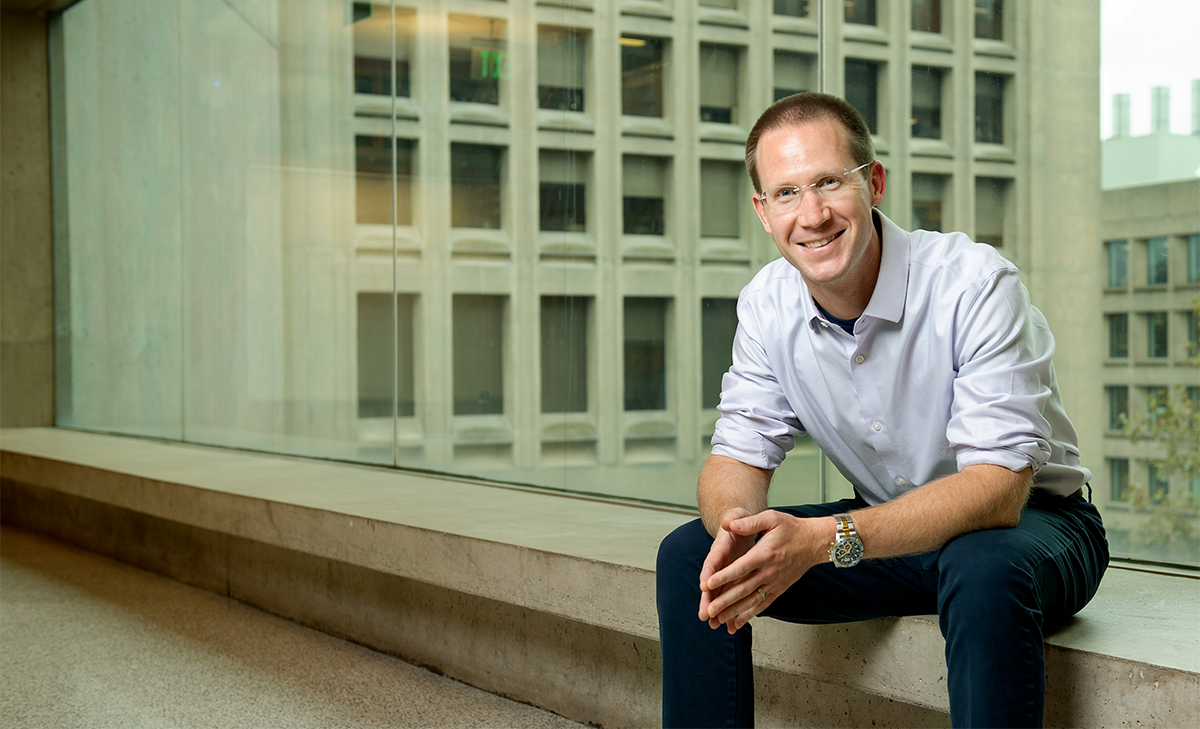 Will Tisdale is the Warren K. Lewis Professor of Chemical Engineering at MIT, where he has been teaching and leading a research team since 2012. His research program is focused on the discovery of hybrid organic-inorganic nanomaterials capable of transporting energy in new ways, and on the use and development of ultrafast laser spectroscopy methods and advanced optical microscopy techniques for probing dynamics at the nanoscale. Will’s contributions to research have been recognized by the Presidential Early Career Award for Scientists and Engineers (PECASE), an Alfred P. Sloan Fellowship, the Camille Dreyfus Teacher-Scholar Award, the DOE Early Career Award, the NSF CAREER Award, the AIChE NSEF Young Investigator Award, and a 3M Non-Tenured Faculty Award.
For his dedication to undergraduate teaching Will has received MIT’s highest honor, the MacVicar Fellowship, as well as the student-selected Baker Award, the School of Engineering’s Amare Bose Award, and he is a 7-time recipient of the C. Michael Mohr Undergraduate Teaching Award, which is voted annually by the Chemical Engineering undergraduate students at MIT. Will graduated magna cum laude from the University of Delaware in 2005, earning an Honors B.S. in Chemical Engineering, with Distinction, and minoring in Economics. He earned a Ph.D. in Chemical Engineering at the University of Minnesota in 2010, then studied as a postdoctoral associate in the Research Laboratory of Electronics at MIT before joining the faculty in Chemical Engineering in 2012.